
Top Signs You Need Garage Door Service – Don’t Ignore These
A door that takes two seconds longer to fully open than it did six months ago isn’t slowing down from age. It’s telling you the spring tension has degraded to the point where the opener motor is compensating for it. Most garage door failures don’t arrive without warning at all. They produce very specific mechanical signals, and those signals get filed away as “normal aging” right up until a spring snaps or a cable frays through. If you’d rather not spend your morning diagnosing it yourself, call (855) 658-3404.
6 signs you need garage door repair
The six signs that matter most are slow or labored opening, a door that reverses before closing, new noises, a visible gap at the bottom seal, a door that won’t stay halfway up, and an opener that hesitates under normal load. Any one of these points to worn springs, a misaligned track, a damaged cable, or a tired opener. In our experience around Ashburn, homeowners catch the sound first and dismiss it, then notice the speed later. Here’s what each one actually predicts.
- Slow, labored opening: the spring is losing tension and the motor is picking up the slack. This is the earliest reliable sign.
- Door reverses before it closes: either the safety sensors or a binding track is telling the opener the path isn’t clear.
- New or louder noises: a ping, a slap, or a grind. Each means something different, covered below.
- Visible gap at the bottom seal: a closed door that doesn’t meet the floor evenly is loaded crooked, which usually means a cable or track problem.
- Door won’t hold halfway up: the balance is gone. This is a spring or cable symptom, not an opener symptom.
- Opener hesitation or grinding under normal load: the motor is straining against door hardware that isn’t moving freely.
If two or more of these are showing up together, the door doesn’t need a tune-up. It needs a proper diagnosis. If you’re in Ashburn and want a professional to look at it, our garage door repair service covers exactly this kind of call.
What each garage door sound is telling you
A single sharp ping that repeats as the door moves is a torsion spring under stress, and it’s the sound a spring makes before it lets go. A rhythmic slap is a cable slapping against the drum or track. A low grind that builds through the travel is a worn roller or a dry hinge. Three sounds, three different fixes, and none of them are cosmetic. Sound is the fastest diagnostic tool a homeowner has, because you hear a problem before you can usually see one.
The coil ping
This one is the most serious. Torsion springs coil and uncoil with the door’s travel, and when a section of the coil has developed a weak point, it makes a metallic ping or pop. It doesn’t mean the spring has failed yet. It means it’s on the way. A torsion spring under tension stores a serious amount of energy, and replacing one by hand is genuinely dangerous work. We treat spring replacement as a core competency for exactly this reason, not a side task. If you hear this sound, stop cycling the door and get it looked at.
The cable slap
A cable that slaps or slaps and then catches is usually slack, seized at the drum, or pulled loose at an anchor point. Slack cable on one side means the door is hanging unevenly, and that unevenness feeds back into the springs and the opener. A frayed cable strand is a “stop using the door now” situation, not a “get to it this month” situation.
The roller grind
The least urgent of the three, but still worth a look. Worn steel rollers grind, and nylon rollers on a Clopay or Amarr door can flat-spot and rumble. Grinding rollers raise the effort the opener has to overcome, which stress-tests the weak points in everything upstream. Cleaning and lubricating the rollers is a small job. Replacing them is a modest one. Ignoring them long enough to chew through the opener is neither.
How do you test garage door balance in 30 seconds?
Disconnect the opener using the manual release, lift the door to about waist height, and let go. A balanced door stays put. A door that sinks to the floor means the springs have lost tension. A door that wants to rise on its own means the tension is too high. Either result says the spring system is out of tune, and the test takes half a minute. Do the test on a door that’s already suspect, not on a door that’s making a coil ping or has a visibly damaged cable.
This is the single most useful thing you can check at home. Spring wear is invisible in the early stages. The balance test converts that invisible wear into a binary answer: holds or sinks. If it sinks, the opener is doing work the springs should be doing, and every cycle accelerates the wear. A garage door opener repair call that turns out to be a spring problem is a common misdiagnosis, and the balance test settles it before anyone touches the motor.
What a gap under the garage door really means
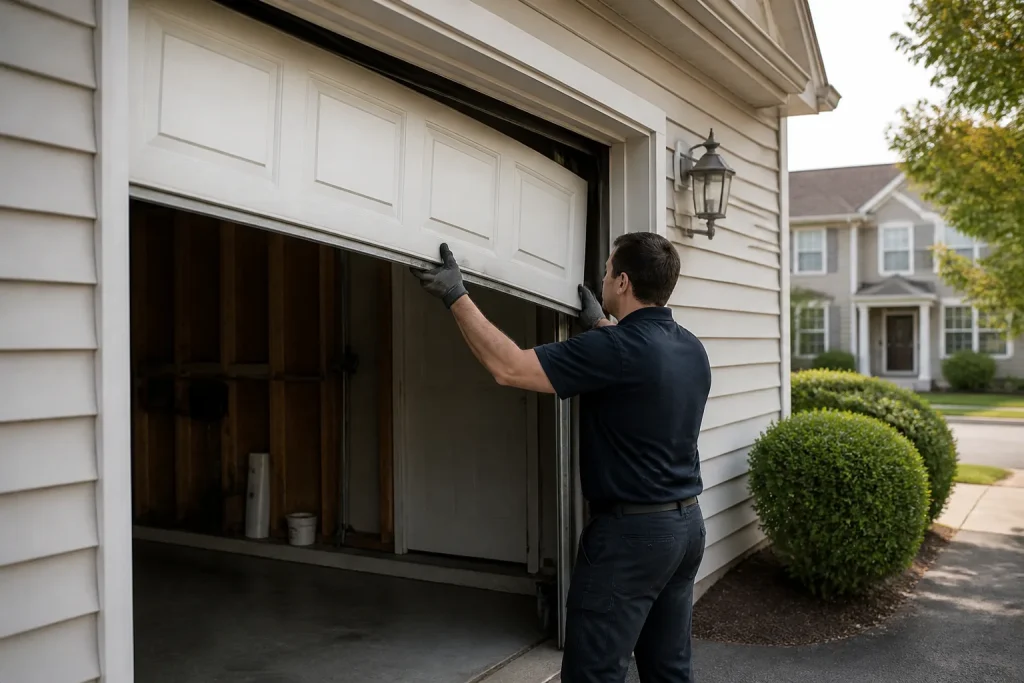
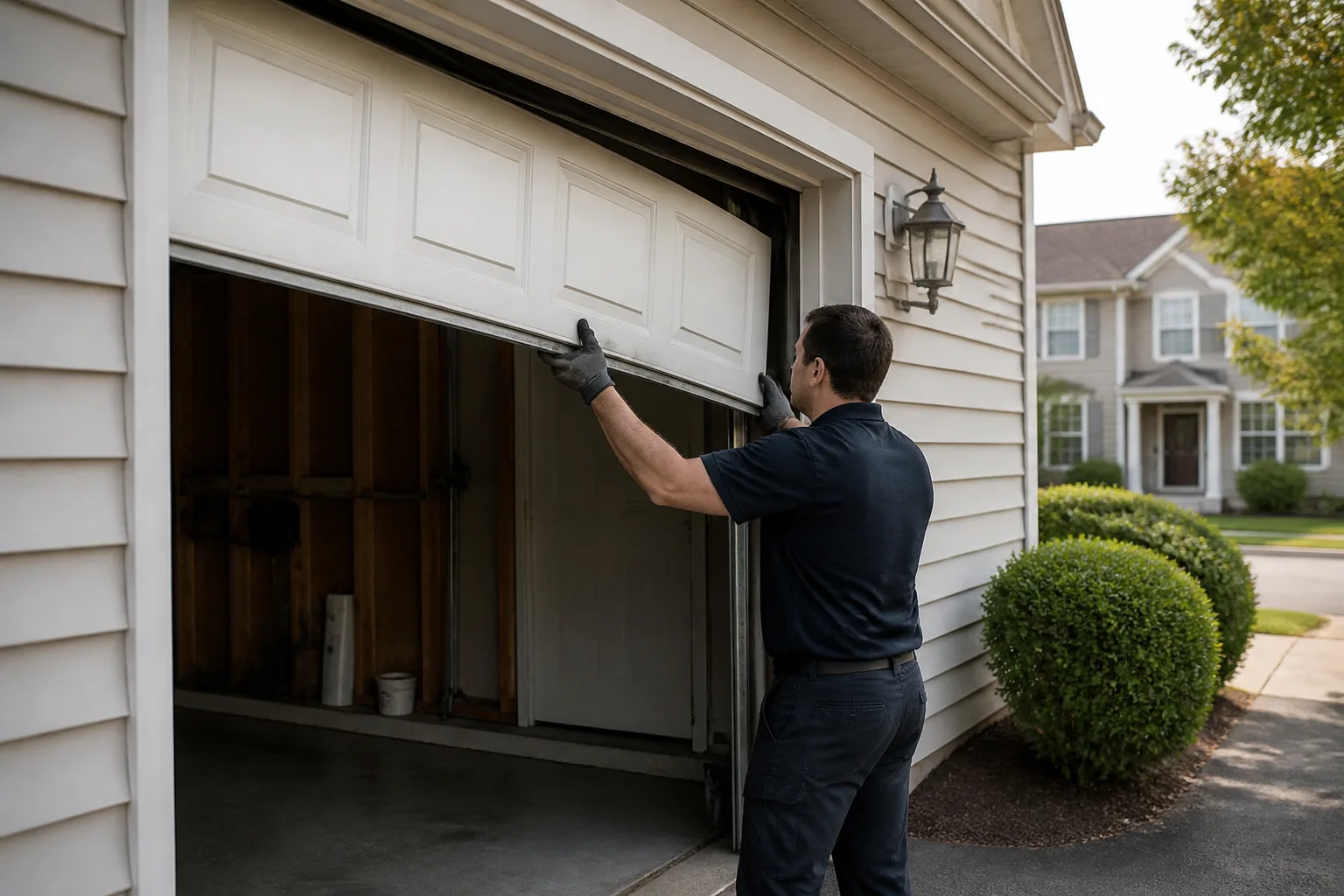
A thin, even gap is weatherproofing. An uneven gap is structural. If one corner of the door meets the floor and the other doesn’t, the door is coming down crooked, and a door that travels crooked is loaded unevenly. That points to a cable out of tension on one side or a track that’s drifted out of plumb. In Ashburn, the wide temperature swings through the year push steel tracks and the framing they’re bolted to in small increments, and the pull on a cable makes the drift worse over months, not days.
This is one of the failures that gets misread as “the door just doesn’t seal well.” It’s not a weatherstrip problem if it’s lopsided. A well-seated Wayne Dalton or Clopay door should meet the floor with a consistent line of contact. If it doesn’t, and it’s getting worse, the door is telling you it’s out of alignment under load. Continuing to run it that way works the springs and the opener harder on every cycle. It’s the kind of fault where two weeks of patience turns into a larger repair, not a smaller one.
When the opener is the symptom, not the problem
Most “my opener is failing” calls are actually door hardware problems. An opener that hesitates at the same point in the travel, or reverses a foot off the floor, or grinds when the door is at its heaviest, is usually doing its job against a door that’s fighting it. The opener is a motor. The motor is remarkably durable. The springs, rollers, and cables around it are not. That pattern holds across every brand we work on and is the first thing worth checking.
There’s a real diagnostic difference between the two. An opener fault tends to show up as a head-unit problem: the remote drops range, the wall button doesn’t respond, the light flashes a code. A hardware fault shows up as a travel symptom: hesitation, reversal, shudder during a specific segment of the run. We work on Genie, LiftMaster, Chamberlain, and Craftsman openers specifically, so the pattern is familiar. If the unit is Wi-Fi or app-controlled and the door behavior changed without any app change, that alone points away from the motor.
When to call a pro
Call when a spring makes noise, when a cable is frayed or slack, when a door reverses on its own, or when the balance test fails. Those are stop-and-think situations. The electrical side of an opener has its own risk, and line voltage isn’t a DIY project.
How long can you safely run a door with early symptoms?
A slow door or a rumbling roller can usually run for a short while with monitoring, measured in days rather than months. A door that’s pinging, popping, uneven, or failing the balance test should stop being used entirely until it’s inspected. That line matters, because the difference between a spring replacement and a bent panel or a damaged opener is often just how long the door keeps running after the warning. Our technicians have up to 12 years of experience, and the pattern is consistent: the door that fails catastrophically was almost always the door that had a symptom someone hoped would go away.
One small mercy: a door that quits at 7 AM in Ashburn is a morning problem, not a catastrophe, because we answer 24/7 and run fast dispatch from 7am to 7pm, Sunday through Friday, closed Saturday. If a door fails on a Saturday, call and we’ll book you for Sunday. Same-day service is real. A door that can still be closed and locked is not an emergency, and a rough estimate is free, so get the quote before anything is taken apart.
Related services in Ashburn
Symptoms pointing toward a full replacement rather than a repair belong on our garage door installation page. Everything on this page sits within Ashburn Garage Door Repair Pros, the full service we run for repair, installation, openers, springs, and emergencies.
The Bottom Line
The warnings are specific: a slower cycle, a coil ping, an uneven gap at the floor, a door that sinks during the balance test. Those are the signals to act on, and they almost always show up before the expensive failure. If you’re in Ashburn and need help, Ashburn Garage Door Repair Pros offers free estimates. Call (855) 658-3404. We answer 24/7, and fast dispatch runs from 7am to 7pm, Sunday through Friday. The price is quoted and agreed before any work starts, so there’s no surprise invoice on the other side.
Frequently Asked Questions
The first signs are a door that opens more slowly than it used to, a door that reverses before closing, and any new sound during the travel. A failing balance test (the door sinks instead of holding when you release it at waist height) is the clearest confirmation of spring wear. Call (855) 658-3404 for a free estimate if two or more are showing up at once.
A broken spring is an emergency if the door is left hanging or can’t be secured. Stop using the door immediately and don’t attempt the replacement yourself, because torsion springs store dangerous energy. Call (855) 658-3404 and we’ll get a qualified technician out to evaluate it. We answer 24/7, with fast dispatch from 7am to 7pm, Sunday through Friday.
A roller grind can usually run a few days with monitoring. A coil ping or a cable slap should stop the door being used until it’s inspected, because both point to failures that get worse with every cycle. Call (855) 658-3404 for a free estimate and get the diagnosis before the repair gets more expensive.
A door that reverses mid-travel is usually tripping the safety sensors or binding on a track that’s out of alignment, not failing at the opener itself. The opener is responding to resistance it shouldn’t be feeling. Call (855) 658-3404 for a free estimate and we’ll trace the door hardware before assuming the motor is the cause.
Written by the team at Ashburn Garage Door Repair Pros.
Need Garage Door Help?
Call Ashburn Garage Door Repair Pros - the local pro we connect you with is licensed and insured, here with fast help in Ashburn.
(855) 658-3404