
Garage Door Repair: Repair or Replace? How Ashburn Homeowners Decide
Deciding whether to repair or replace a garage door usually comes down to a simple test: if the repair bill lands under roughly 30% of what a new door costs, repair almost always wins. Above that line, and especially when a second or third problem is waiting behind the first, replacement is the smarter money. The tricky part is that homeowners tend to make this call on age alone. The door’s age matters far less than the cost of the next likely failure, how the damage affects insulation, and whether the existing door can even work with a modern opener. If you’d rather have a specialist look at it than guess, call (855) 658-3404.
A 15-year-old door with one broken spring is usually a repair. A 15-year-old door with a broken spring, two cracked panels, and an opener that predates any smart-home compatibility is a replacement calculation, not a repair call. That’s the honest framework we work through on every estimate in Ashburn.
Key Takeaways
- Use the 30% rule: repairs under about 30% of replacement cost are usually worth doing.
- Where a crack sits on the panel changes the structural math – center cracks are worse than end damage.
- Attached garages in Ashburn’s climate make insulation upgrades pay back faster than detached ones.
- An opener that can’t pair with a modern system drags down the value of every repair dollar.
- Get replacement quotes that match steel gauge, insulation tier, and spring type, or the comparison is meaningless.
What’s the repair-versus-replace cost threshold for an Ashburn garage door?
The threshold is a percentage, not a dollar figure: once a repair quote climbs past roughly 30% of the price of a new door, replacement deserves serious weight. A typical single-car door in the Ashburn market runs somewhere in the low four figures installed, so a repair in the several-hundred-dollar range is a clear repair. When the numbers start crowding each other, that’s your signal to compare honestly rather than patch and hope.
Here’s how the math usually breaks down:
- Single spring snap: a routine repair. This falls well under the threshold and is worth doing on almost any door with sound panels.
- Matched spring pair: still comfortably a repair. Springs are replaced as a pair, so the cost roughly doubles the single-spring figure, but it stays in repair territory.
- Springs plus a cracked panel or an opener fault: now you’re stacking repairs. Add them up before you commit to any one of them.
- Two or more structural problems plus an aging opener: this is where replacement usually wins on cost over the next few years.
The trap is treating each failure as an isolated event. A door that needs a spring this year, a panel next year, and an opener the year after costs more across three visits than one replacement. Our technicians have up to 12 years of experience reading that pattern, and spring repair is a core service for us because it’s the failure that starts the conversation most often. If the panel damage runs deeper than a spring, garage door repair can still be the right call – it depends on what the estimate actually shows.
How does panel damage location change the repair-versus-replace call?
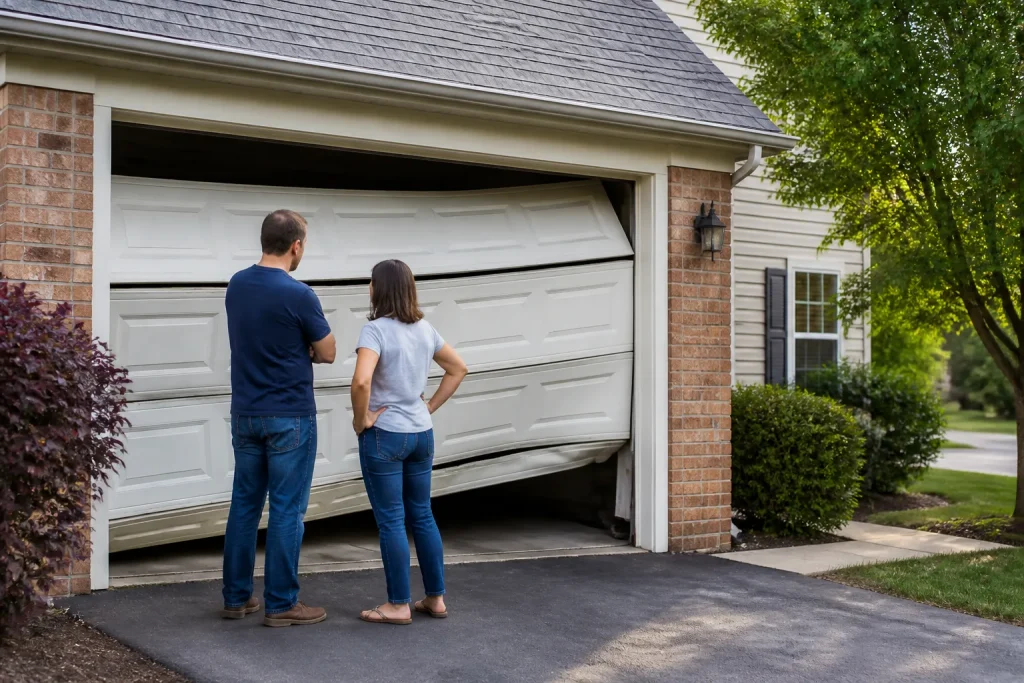
Where a crack or dent sits on the door matters as much as whether it exists. Damage at the end panels or the bottom section is often replaceable in pieces, which keeps the door in repair territory. Damage running through the center panels, or several sections at once, changes the structural picture and usually pushes the decision toward replacement.
Think of it this way:
- Center panel cracks: the middle of the door carries the most flex and stress. A crack here tends to spread, and patching it rarely holds. Replacement earns serious consideration.
- End panel damage: the outer sections are the easiest to swap out on many panel-style doors, including systems from Amarr and Wayne Dalton. Often a genuine repair.
- Bottom section rust or rot: the bottom panel sits closest to the ground and takes the most moisture. On a sectional door it’s frequently replaceable on its own, so a rusted bottom doesn’t automatically mean a new door.
- Multiple sections involved: when damage spans two or more sections, the labor and parts add up fast, and the 30% threshold gets crossed quickly.
We look at whether the door is still tracking squarely on its rails and whether the panels are still aligned with each other. A door with a cracked center panel that’s also sagging out of alignment is telling you two things at once. Fixing the crack without addressing the alignment just delays the bigger bill.
Does insulation and energy performance push Ashburn homeowners toward replacement?
For an attached garage, yes – more often than people expect. Ashburn’s climate swings from humid summers to genuinely cold winters, and an attached garage shares walls and sometimes a ceiling with the living space. A poorly insulated door on that shared wall lets heat move in both directions, and that load shows up on your HVAC bill whether you notice it or not.
When a door is already facing a major repair, the insulation question becomes part of the same decision rather than a separate one. Upgrading to a higher insulation tier during replacement folds the energy benefit into a cost you were going to spend anyway. Retrofitting insulation onto an old door costs money too, and it doesn’t fix cracked panels or a failing spring.
The math shifts depending on your setup:
- Attached garage with living space above or beside it: insulation gains matter here. Replace when you’re already facing a major repair.
- Detached garage: the energy case weakens considerably. A repair on a sound structure is usually the better spend.
- Garage used as a workspace or gym: comfort becomes part of the value, and a higher-tier insulated door pulls its weight.
Brands like Clopay and Raynor build doors across several insulation tiers, so there’s room to match the upgrade to what your garage actually needs rather than overspending on a detached structure that won’t benefit. If you’re weighing that upgrade, our garage door installation team can walk you through the tiers against your specific layout.
Which opener limitations make a door a poor candidate for further repair investment?
An opener that can’t work with a modern smart-home system drags down the value of every repair dollar you put into the door. If the motor predates app control, Wi-Fi pairing, or current safety-reverse standards, you’re sinking money into a door that’s still going to feel dated the day the repair is done. That’s the point where the repair-versus-replace math tilts.
Watch for these signals:
- No Wi-Fi or app pairing: the opener can’t join a modern home automation setup, so you lose control and monitoring you’d otherwise have.
- Parts scarcity: older logic boards and remotes get hard to source, which drives up repair costs on the opener itself.
- Safety feature gaps: an opener without current safety-reverse protection is a liability, not an asset, on a door the family uses daily.
- Strain on the door: a tired opener working against a heavy or misaligned door accelerates wear on both.
We work on LiftMaster, Chamberlain, Genie, and Craftsman systems specifically, so we can tell you quickly whether your opener is a fixable unit or a candidate for replacement alongside the door. Sometimes the honest answer is that the door is fine but the opener is the weak link – and garage door opener repair resolves it without touching the door at all. Other times the opener and the door move together, and that’s a replacement conversation.
How do I get a replacement quote that’s genuinely comparable?
You get a fair comparison by making sure every quote is pricing the same thing: same steel gauge, same insulation tier, same spring system, same opener provision. A cheaper quote that swaps in thinner steel or a single-spring setup isn’t a better price – it’s a different product. Line them up apples to apples and the repair-versus-replace math becomes honest.
Ask each quote to spell out:
- Steel gauge and construction: thickness and build quality drive both durability and price. A thinner door is cheaper for a reason.
- Insulation tier and R-value: match the tier to whether the garage is attached or detached, not just to the lowest number.
- Spring system: torsion versus extension, and whether it’s a single spring or a matched pair.
- Opener provisions: whether the quote includes a new opener or works with your existing one.
- Installation and disposal: confirm the old door comes out and the new one is hung and balanced.
A genuinely comparable quote lets you see exactly where the savings come from, and that transparency is where a specialist beats a generalist. We price installation, repair, opener systems, and spring work all within the garage door trade, so nothing gets subbed out or guessed at. Get the written estimate in hand and compare line by line before you sign anything.
When to call a pro
Spring work is where the DIY line gets serious. Torsion and extension springs are under heavy tension, and a spring that lets go while you’re near it can cause real injury. That’s a job for a trained technician, not a weekend project, and it’s why we treat spring replacement as a core competency rather than an afterthought. If the door won’t open, the spring has snapped, or the opener is dead, that’s the moment to call rather than improvise. We answer 24/7, with fast dispatch from 7am to 7pm, Sunday through Friday.
Related services in Ashburn: whether you land on repair, Ashburn Garage Door Repair Pros, or a full replacement, we cover the whole garage door spectrum so you’re not bouncing between trades.
The Bottom Line
Repair wins when the bill stays under roughly 30% of replacement cost and the damage is contained. Replace when repairs stack up, when center panel cracks or multiple damaged sections cross that threshold, when an attached garage makes insulation upgrades worth folding in, or when the opener can’t keep pace with a modern system. The door’s age is the least reliable factor in the whole decision. Weigh the next likely failure, the insulation impact on your particular garage, and the opener’s compatibility – those three tell you more than a build year ever will.
If you’re in Ashburn and need help working through the call, Ashburn Garage Door Repair Pros offers free estimates – call (855) 658-3404. We answer 24/7. Fast dispatch from 7am to 7pm, Sunday through Friday. The price is quoted and agreed before any work starts, so you’ll know the number going in.
Frequently Asked Questions
Add up the repair quotes and compare the total to about 30% of a new door’s installed cost. If the repairs stay under that line and the panels are structurally sound, repair. If they cross it, or if multiple problems are stacked, replacement is usually the better spend. Call (855) 658-3404 for a free estimate and we’ll run the numbers with you.
No. A broken spring on a door with sound panels and a working opener is almost always a repair, not a replacement. Springs are replaced as a pair, so expect roughly double a single-spring cost, but that’s still far below a new door. Spring work is dangerous to handle yourself – call a technician. (855) 658-3404 for an exact quote, and estimates are free.
It can, but mainly on an attached garage where the door shares a wall with living space. Ashburn’s cold winters and humid summers make an insulated door worthwhile there. On a detached garage, the savings are much smaller and often don’t justify replacement on their own. We’ll help you weigh the insulation tier against your layout – call (855) 658-3404.
Often, yes. Spring repairs and opener faults are same-day work when the parts are on hand. A replacement door is a scheduled project – it has to be measured and ordered first. Either way, the price is set by a written estimate before we start. Call (855) 658-3404. We answer 24/7. Fast dispatch from 7am to 7pm, Sunday through Friday.
Written by the team at Ashburn Garage Door Repair Pros.
Need Garage Door Help?
Call Ashburn Garage Door Repair Pros - the local pro we connect you with is licensed and insured, here with fast help in Ashburn.
(855) 658-3404